Lu Xun
The Romance of the Three KingdomsLu Xun emerges as a strategist whose defining strength is the ability to wait while others demand action. His campaigns turn apparent passivity into control of the enemy’s timing, confidence, and position. At the same time, the narrative makes his authority precarious: he must persuade skeptical commanders to follow him, and his victories do not secure lasting unity among Wu, Shu, and Wei.
Identity and Authority
Sun Quan appoints Lu Xun to command Wu’s response to Liu Bei’s invasion, choosing a young scholar rather than a celebrated warrior. The appointment provokes mockery among martial advisers, including Zhang Zhao, and officers continue to disdain him when he reaches the front. Sun Quan nevertheless gives him full authority on the battlefield. That grant matters because Lu Xun’s strategy depends on being able to hold the army back even when its commanders believe an immediate attack is necessary.
The pressure becomes explicit when Sun Huan is trapped at Yiling. Lu Xun refuses to divert his forces to rescue him, arguing that the western army must first be defeated. His refusal brings dissent close to mutiny, but he faces down his own generals and maintains a defensive posture. The account presents command not as a matter of winning respect in advance, but as the capacity to keep control when subordinates openly doubt the plan.
Patience Against Liu Bei
Liu Bei advances with a line of forty camps extending across several hundred miles, seeking revenge for Guan Yu’s defeat and death. Lu Xun does not answer the scale of the deployment with an immediate assault. He recognizes that summer heat and overstretched supply lines will expose the invading army to fatigue and shortages. Even when Shu soldiers taunt the Wu forces daily, he keeps his men from being drawn into battle.
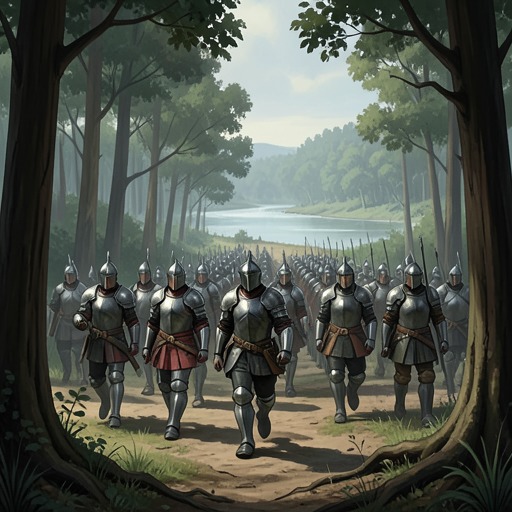
Liu Bei eventually moves most of his soldiers into the shelter of the woods, leaving weaker troops on the plain and a reserve nearby to spring an ambush. Lu Xun identifies this arrangement as bait rather than opportunity. He warns his commanders that Liu Bei is trying to lure Wu into a trap, predicts that further troops are concealed at a distance, and tells them to wait three days. When the expected movement appears and Liu Bei shows himself with the ambush force, Lu Xun judges that the Shu army is now bored, frustrated, and vulnerable. His patience has turned the enemy’s own attempt at deception into the signal to attack.
Lu Xun first tests the condition of the Shu encampments by sending out an expeditionary force against a southern camp. The force is defeated, discouraging his commanders, but he explains that the sortie was a test of the enemy’s preparedness. He then sets his plan in motion: Zhu Ran is to advance upstream by boat; Han Dang and Zhou Tai are to attack from opposite shores; and soldiers are to carry straw bundles containing explosive materials and ignite the camps. The objective is to set fire to all forty camps and pursue the disordered army.
The assault catches Liu Bei’s forces amid confusion. Fires break out on both sides of his position, while Wu troops rush toward the camps and attack through the disorder. Liu Bei escapes after Zhang Bao carries him away with the Royal Guard, but the army’s encampments are destroyed and the fleeing forces are pursued. The narrative’s reversal is sharp: commanders who had read Lu Xun’s restraint as weakness see that he had been waiting for the moment when an attack would have decisive effect.
The Threat from Wei
Lu Xun’s withdrawal after the victory is not a retreat from strategic responsibility. He is alarmed by the prospect that Cao Pi will exploit Wu’s success against Liu Bei and attack while Wu is occupied. Two days later, news arrives that a large Wei force has assembled on the border. Lu Xun says he expected this and has already made arrangements to meet it.
Cao Pi does invade, despite advice from Jia Xu and Liu Ye to hold back. The Wei forces are defeated on several fronts: Zhu Huan defeats Cao Ren’s attack, Lu Xun helps crush Cao Zhen’s force at Nanjun in coordination with Zhuge Jin, and Lü Fan defeats Cao Xiu. The narrative also reports that summer plague causes three quarters of Cao Pi’s troops to collapse and die. Cao Pi retreats, regretting that he ignored his advisers. Lu Xun’s foresight thus extends beyond the battlefield against Liu Bei: he anticipates that one enemy’s defeat will create an opening another ruler may try to exploit.
His later victory over Cao Xiu develops the same theme of misleading appearances. Zhou Fang, a Wu governor, pretends to offer his territory to Wei, and Cao Xiu trusts him after Zhou Fang cuts off his hair to demonstrate supposed loyalty. Jia Kui remains suspicious, but Cao Xiu dismisses the warning. Lu Xun recognizes that Cao Xiu’s appointment rests on his imperial family connection rather than military ability. He uses a series of feigned retreats to draw the Wei commander into successive ambushes. The defeat is total; Cao Xiu barely escapes, with Jia Kui’s military judgment helping him survive. Lu Xun returns to Wu with captured men and substantial quantities of weapons and horses.
Alliances, Reversals, and Narrative Role
After the victory over Cao Xiu, Lu Xun proposes an alliance between Wu and Shu for a joint attack on Wei. Sun Quan supports the proposal, and Wu sends a letter to Shu. This decision makes Lu Xun’s strategic role broader than winning individual battles: he seeks to convert battlefield success into a coordinated political and military advantage.
That cooperation does not hold. During a later campaign, the Wu invasion led by Zhuge Jin fails and costs Wu many men. Lu Xun devises plans against Wei, but they repeatedly fall into enemy hands through subterfuge. Unable to advance, he withdraws the Wu army, leaving Kong Ming to face the campaign alone. The contrast is consequential: the strategist who had foreseen danger and secured major victories cannot make an alliance immune to deception or prevent a failed expedition from isolating Wu’s former partner.
Across these episodes, Lu Xun’s characteristic method is to read what others overlook: the strain of an army’s supply lines, the purpose behind a tempting opening, the risk of a new front, and the credibility of an apparent defector. His refusals to attack can look like indecision, but the narrative repeatedly reveals them as calculated choices. Yet his victories remain contingent on political trust and reliable intelligence. He can turn patience into advantage, but he cannot ensure that the larger contest among Wu, Shu, and Wei will follow his preferred design.